
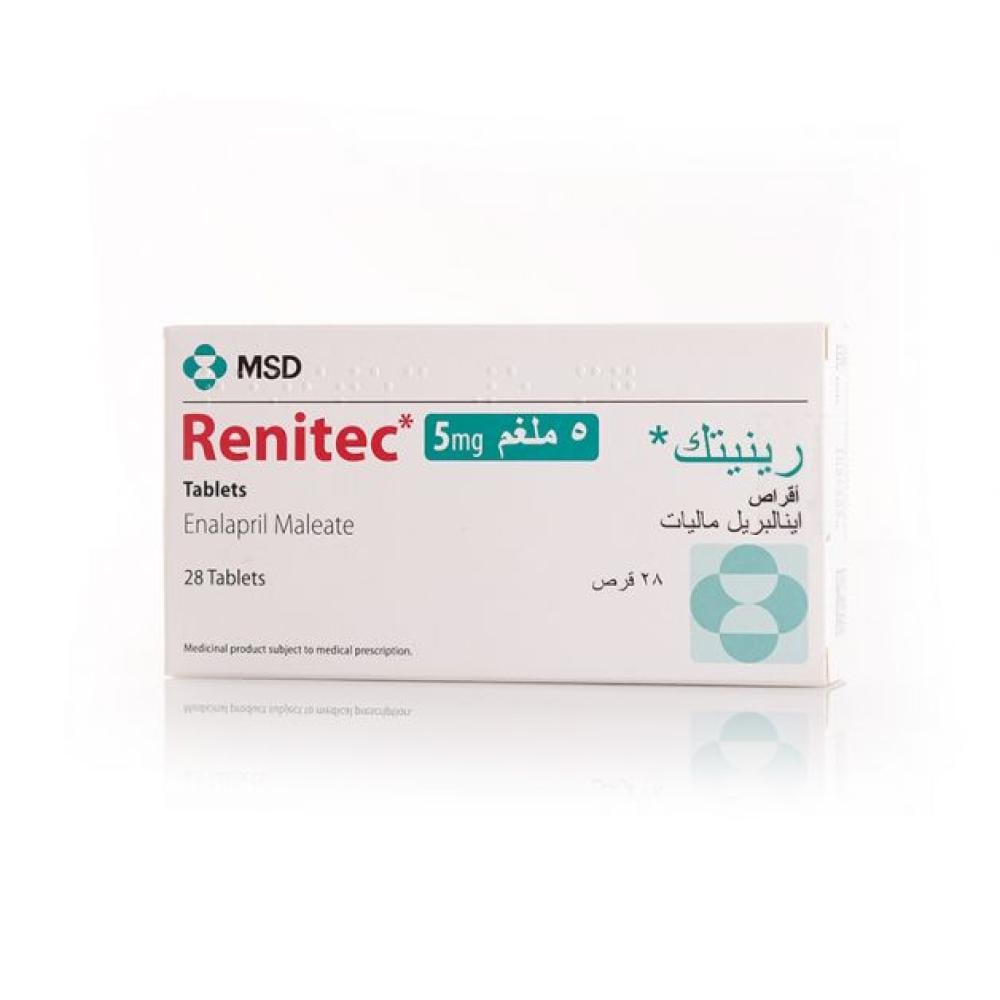
Renitek 5 mg 28 tablets

Enalapril 5 mg tablets
What is Enalapril and what are its uses?
Enalapril belongs to a class of drugs called angiotensin-converting enzyme (ACE) inhibitors. It works by causing blood vessels to relax, lowering blood pressure, and increasing the supply of blood and oxygen to the heart.
Enalapril is used for
• Treatment of high blood pressure (hypertension)
• Treatment of heart failure (weakened heart function). It can reduce the need for hospitalization and can help some patients live longer.
• Preventing signs of heart failure. Signs include shortness of breath, fatigue after light physical activity such as walking, or swelling of the ankles and feet.
This medication works by widening the blood vessels. This lowers blood pressure. The medication usually starts working within an hour, and the effect lasts for at least 24 hours. Some people may need several weeks of treatment to see the best effect on their blood pressure.
What you need to know before using Enalapril
Do not use Enalapril
• If you are allergic (severely allergic) to enalapril maleate, or any of the other ingredients in these tablets or ACE inhibitors
• If you have previously experienced swelling of your face, lips, mouth, tongue, or throat that caused difficulty swallowing or breathing (angioedema) when the cause was unknown or hereditary.
• If you are more than 3 months pregnant. (It is also best to avoid enalapril maleate tablets in early pregnancy.)
• If you have diabetes or impaired kidney function and are being treated with blood pressure-lowering medications containing aliskiren.
• If you have ever had an allergic reaction to a type of drug similar to this one called angiotensin-converting enzyme inhibitors (ACEIs).
• If you have taken or are currently taking sacubitril/valsartan, a medicine used to treat a type of long-term (chronic) heart failure in adults, your risk of developing angioedema (rapid swelling under the skin in an area such as the throat) has increased.
Precautions and warnings
You should tell your doctor the following:
• If you have a heart problem
• If you have a condition involving blood vessels in the brain
• If you have a blood problem such as low or deficient white blood cells, low platelet count, or low red blood cell count (anemia)
• If you have a kidney problem (including a kidney transplant), this can lead to dangerously high potassium levels in your blood. Your doctor may need to adjust your enalapril dose or monitor your blood potassium levels.
• If you are very ill (severe vomiting) or have recently had severe diarrhea
• If you suffer from diabetes.
• If you have a liver problem or develop jaundice (yellowing of the skin and whites of the eyes)
• If you are undergoing dialysis
• If you are over 70 years old
• If you are experiencing low blood pressure (you may notice this as weakness or dizziness, especially when standing)
• If you have a collagen vascular disease (such as systemic lupus erythematosus, rheumatoid arthritis, or scleroderma), or if you are taking medication that suppresses the immune system, or are taking allopurinol or procainamide, or any combination of these
• If you think you are (or might become) pregnant.
Other drugs and inalapril
It is especially important to tell your doctor if you are taking any of the following:
• Angiotensin II receptor blockers (ARBs) or aliskiren
• Other medications that lower blood pressure, such as beta-blockers, vasodilators, or water pills (diuretics)
• Potassium supplements (including salt substitutes), potassium-sparing diuretics, and other drugs that can increase the amount of potassium in the blood (e.g., trimethoprim and cotrimoxazole for bacterial infections; cyclosporine, an immunosuppressant drug used to prevent organ transplant rejection; and heparin, a blood thinning drug used to prevent clots).
• Lithium, which is used to treat a certain type of depression
• Tricyclic antidepressants such as amitriptyline are used to treat depression
• Medications for mental health problems called 'anticoagulants'
• Some cough, cold, and weight loss medications contain substances called 'sympathomimetic agents'
• Some pain or arthritis medications, including gold therapy.
• Antidiabetic medications, including oral medications to lower blood sugar and insulin
• Nonsteroidal anti-inflammatory drugs (NSAIDs), including COX-2 inhibitors (drugs that reduce inflammation, and can be used to help relieve pain)
• Aspirin (acetylsalicylic acid)
• Medications used to dissolve blood clots (thrombotic condition)
• Drugs that are most often used to prevent rejection of transplanted organs (sirolimus, everolimus and other drugs belonging to the mTOR inhibitor class).
• Medications containing neprilysin inhibitors, such as sacubitril (available as a fixed-dose combination with valsartan), used in patients with heart failure, and racecadotril, may increase the risk of angioedema (swelling of the face, lips, tongue, or throat with difficulty swallowing or breathing).
How to use Enalapril
Always take your medicine exactly as your doctor has told you. If you are unsure how to take your tablets, ask your doctor or pharmacist.
• Do not take more tablets than prescribed.
• You should take your tablet at the same time every day unless your doctor tells you otherwise.
• If you are taking your medication twice a day (two tablets a day), take one tablet in the morning and one in the evening, unless your doctor tells you otherwise.
The recommended dose is to be swallowed with a glass of water:
Adults
High blood pressure:
• The recommended starting dose is 5 mg to 20 mg taken once a day
• Some patients may require a lower starting dose
• Long-term dose of 20 mg taken once daily
• The maximum long-term dose is 40 mg once a day
heart failure:
• Starting dose: 2.5 mg taken once a day
Your doctor will gradually increase this amount until the appropriate dose is reached for you.
• The long-term dose of 20 mg is taken in one or two doses.
• The maximum long-term dose is 40 mg daily, divided into two doses.
Elderly people (65 years and over)
Your doctor will determine your dose, and it will depend on how well your kidneys are working.
Patients with kidney problems
Your dose of medication will be changed depending on how well your kidneys are working.
Use in children and adolescents
Experience with using this medication in children with high blood pressure is limited. If the child can swallow tablets, the dosage will be calculated using the child's weight and blood pressure.
The recommended starting doses are:
• Between 20 kg and 50 kg - 2.5 mg every day
• Over 50 kg - 5 mg every day.
Possible side effects
Stop using the product and seek immediate medical attention if
• Swelling of the face, lips, tongue, or throat, which may cause difficulty breathing or swallowing.
• Swelling in the hands, feet, or ankles
• Sudden appearance of a rash, burning, redness, or peeling of the skin
• Ringing in your ears (tinnitus)
• Bone marrow suppression (a decrease in the number of blood cells)
• Hepatitis, liver disease, increased liver enzymes or bilirubin (measured by tests), and jaundice (yellowing of the skin and/or eyes)
• Blood disorders, including changes in blood values such as low white and red blood cell counts, low hemoglobin, and low platelet count
• Heart attack (possibly due to a severe drop in blood pressure in some high-risk patients, including those with blood flow problems in the heart or brain)
• Stroke (possibly due to a severe drop in blood pressure in high-risk patients)
• You should be aware that Black patients are more at risk of these types of reactions.
How to store Enalapril
• Keep this medicine out of the sight and reach of children.
Do not take Enalapril after the expiry date on the carton. The expiry date refers to the last day of the month.
• Do not store above 25 degrees Celsius.
• Store in the original packaging.
• Medicines should not be disposed of via wastewater or household waste. Ask your pharmacist how to dispose of medicines you no longer need. These measures will help protect the environment.